


Financial freedom is a phrase that appears frequently in conversations about money, investing, saving, and personal finance. Many people dream about becoming financially free, but the meaning can be different from one person to another.
For some people, financial freedom means being debt-free. For others, it means having enough savings and investments to reduce their dependence on a regular paycheck. Someone else may define it as having enough money to choose how they spend their time without constantly worrying about their finances.
There is no single definition that applies to everyone. However, financial freedom generally involves having enough financial control and resources to make important life decisions without being overwhelmed by money-related pressures.
What Is Financial Freedom?
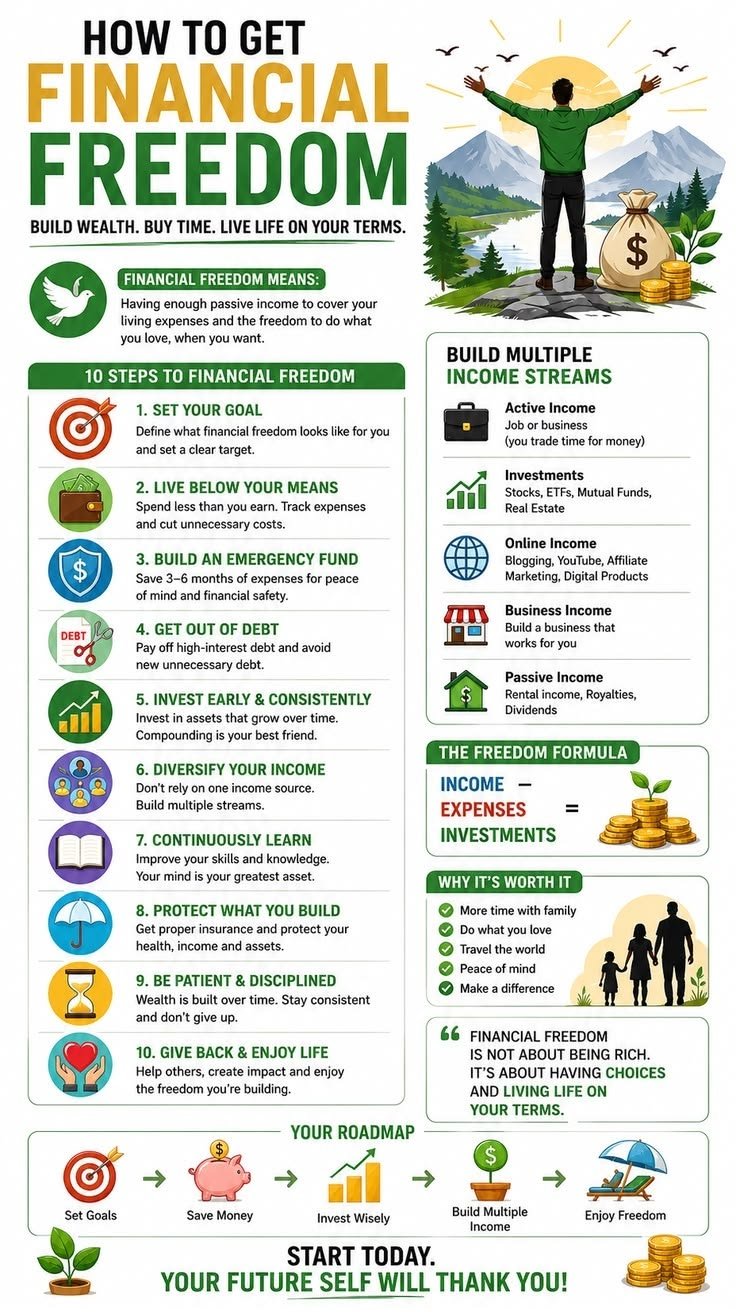
Financial freedom generally means reaching a financial position where your money provides you with greater flexibility and control over your life.
It does not necessarily mean being extremely wealthy or never working again. Instead, it can mean having enough financial stability to handle your responsibilities, deal with unexpected expenses, and make choices based on your goals rather than immediate financial pressure.
For example, a person with manageable expenses, an emergency fund, limited high-interest debt, and consistent retirement savings may feel financially secure even if they are not wealthy.
Financial freedom is therefore both a financial condition and a personal goal.
Financial Freedom Can Mean Different Things
Everyone has different income levels, expenses, responsibilities, and priorities. As a result, financial freedom can look different for different people.
One person may want to eliminate all consumer debt. Another may want to save enough money to leave a stressful job and pursue a different career.
For someone else, financial freedom may mean being able to travel without worrying about every expense. A parent might define it as having enough resources to support their children’s education.
Because of these differences, comparing your financial progress with someone else’s can be misleading. Your definition of financial freedom should reflect your own circumstances and goals.
The Importance of Financial Stability
Financial freedom usually starts with financial stability.
Before focusing on long-term wealth, it can be useful to establish a strong foundation. This may include maintaining a manageable budget, paying bills on time, building emergency savings, and managing debt responsibly.
Financial stability can make it easier to deal with unexpected situations.
For example, if your car suddenly needs an expensive repair, having savings available can reduce the need to borrow money. Similarly, having manageable monthly expenses can give you more flexibility when your income changes.
Building an Emergency Fund
An emergency fund can be an important step toward greater financial freedom.
Unexpected expenses are part of life. Medical costs, vehicle repairs, home maintenance, or changes in employment can create financial challenges.
Emergency savings provide a source of money that can be used for qualifying unexpected expenses without immediately relying on credit cards or loans.
The amount needed will vary depending on your income, expenses, job stability, and responsibilities. Starting with a small savings goal and gradually increasing it can be a practical approach.
Managing Debt
Debt is another major consideration when working toward financial freedom.
Not all debt has the same characteristics. Some forms of borrowing may help finance education, housing, or other long-term goals, while high-interest consumer debt can become expensive and difficult to manage.
Understanding your debt is important. Know how much you owe, the interest rates, minimum payments, and repayment terms.
Paying down expensive debt can free up more of your future income for savings and other financial goals.
Saving and Investing for the Future
Financial freedom often involves building assets that can support future needs.
Saving provides money for short- and medium-term goals, while investing may be used for longer-term objectives.
Investments can include assets such as stocks, bonds, mutual funds, exchange-traded funds, or other investments depending on an individual’s circumstances and objectives.
Investing involves risk, and the value of investments can rise or fall. Therefore, it is important to understand the investments you choose and consider factors such as your time horizon and risk tolerance.
Long-term consistency can be more important than trying to predict short-term market movements.
Increasing Your Income
Reducing expenses is one part of financial planning, but increasing income can also help improve financial flexibility.
You may be able to increase your income by developing valuable skills, pursuing career opportunities, negotiating compensation, starting a business, freelancing, or finding other legitimate income sources.
However, earning more money does not automatically create financial freedom.
If expenses increase at the same rate as income, your financial position may not improve significantly. Combining increased income with disciplined saving and responsible spending can be more effective.
Avoiding Lifestyle Inflation
Lifestyle inflation occurs when spending increases as income increases.
For example, someone who receives a significant raise may immediately move into a more expensive home, purchase a more expensive vehicle, or increase discretionary spending.
There is nothing inherently wrong with improving your lifestyle. The challenge occurs when higher spending prevents you from building savings or investments.
When your income increases, consider directing part of the additional income toward financial goals before increasing your regular expenses.
Financial Freedom Does Not Mean Never Working
One common misconception is that financial freedom means you must stop working completely.
For some people, that may be the goal. However, financial freedom can also mean having the ability to choose whether, where, and how much you work.
Someone may continue working because they enjoy their career even after reaching a strong financial position.
Another person may reduce their working hours, start a business, change careers, or spend more time with family.
The important element is having greater choice.
How Can You Work Toward Financial Freedom?
There is no universal path, but several practical steps can help.
Start by understanding your current financial situation. Calculate your income, expenses, debts, savings, and investments.
Next, create realistic financial goals. These might include building an emergency fund, paying down high-interest debt, increasing retirement contributions, or saving for a major purchase.
Create a budget that supports those goals. Track your spending and review your progress regularly.
As your financial situation improves, consider increasing savings and long-term investments while keeping debt manageable.
Most importantly, give yourself time. Financial freedom is usually a long-term process rather than something that happens overnight.
How Do You Know If You Are Making Progress?
Financial progress can be measured in several ways.
You may have less high-interest debt than you had a year ago. Your emergency savings may have increased. Your retirement contributions may be growing. You may have more control over your monthly spending.
Even small improvements can matter.
Instead of focusing only on a final financial goal, consider monitoring the habits and milestones that move you toward it.
For example, consistently saving $200 every month may seem small at first, but maintaining that habit can create meaningful progress over time.
Final Thoughts
Financial freedom does not have one universal definition. It is a personal financial goal that generally involves having greater control, flexibility, and security when making decisions about your money and your life.
For some people, it may mean becoming debt-free. For others, it may mean building enough savings and investments to have more choices about work and lifestyle.
The journey can begin with simple steps: create a realistic budget, build emergency savings, manage debt, increase your financial knowledge, save consistently, and invest appropriately for your long-term goals.
You do not need to become wealthy overnight to move toward financial freedom. What matters is building sustainable financial habits and gradually creating a financial position that gives you more choices and less dependence on immediate income.