
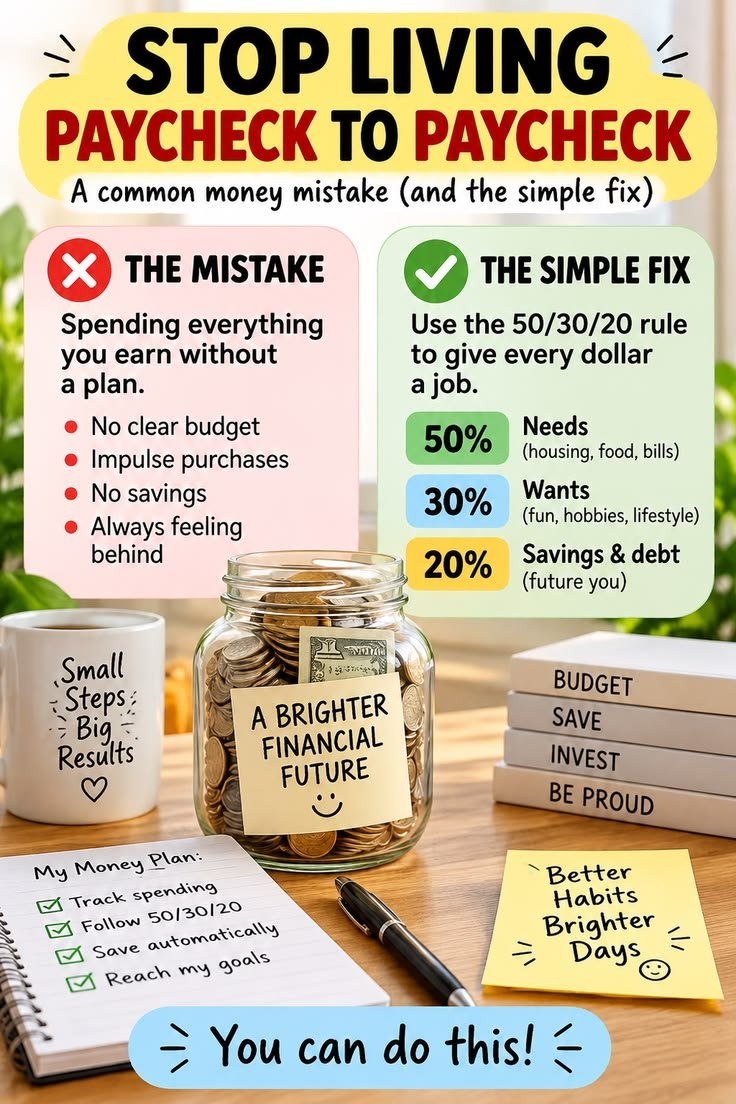
Living paycheck to paycheck can make managing money feel stressful. When most or all of your income goes toward bills and everyday expenses, an unexpected car repair, medical expense, or reduction in income can quickly create financial pressure.
Breaking the paycheck-to-paycheck cycle does not happen overnight. It usually requires a combination of understanding your spending, creating a realistic budget, reducing unnecessary expenses, building savings, and gradually increasing your financial cushion.
The goal is not simply to spend less. It is to create enough financial flexibility that your next paycheck is not immediately needed to cover expenses from the previous month.
1. Understand Where Your Money Goes
The first step is finding out exactly where your money is going.
For at least one month, track every expense. Include large bills as well as small purchases.
Your list might include:
- Rent or mortgage
- Utilities
- Groceries
- Transportation
- Insurance
- Credit card payments
- Student loans
- Subscriptions
- Restaurants
- Entertainment
- Shopping
Once you have the information, divide your spending into essential and non-essential categories.
You may discover expenses that can be reduced without significantly affecting your quality of life.
2. Create a Realistic Budget
A budget can help you decide how your income should be used before you spend it.
Start with your monthly take-home income and list your essential expenses.
For example, suppose your monthly income is $4,000.
Your expenses might look like:
- Housing: $1,500
- Food: $500
- Transportation: $400
- Utilities: $250
- Insurance: $250
- Debt payments: $400
- Savings: $300
- Personal spending: $250
- Other expenses: $150
The numbers are only an example. Your budget should reflect your actual financial situation.
If your expenses consistently exceed your income, the budget makes that problem visible so you can begin addressing it.
3. Build a Small Emergency Fund
When you live paycheck to paycheck, even a small unexpected expense can cause financial problems.
Building an emergency fund can provide some protection.
You do not have to start with a large target. Begin with an amount that feels achievable.
For example:
First goal: $500
Then:
Second goal: $1,000
After that, you can work toward several months of essential expenses.
Having even a small cash reserve can reduce the need to rely immediately on credit cards or loans when something unexpected happens.
4. Reduce Unnecessary Monthly Expenses
Review your recurring expenses and look for services or purchases you do not really need.
Potential areas to review include:
- Streaming services
- Gym memberships
- Premium apps
- Restaurant spending
- Food delivery
- Online shopping
- Unused subscriptions
- Expensive phone plans
Suppose you discover that you are spending $100 each month on subscriptions and services you rarely use.
Reducing those costs could free up $1,200 per year.
You do not have to eliminate everything you enjoy. The goal is to identify expenses that provide little value compared with their cost.
5. Control Impulse Purchases
Impulse spending can make the paycheck-to-paycheck cycle harder to escape.
Before making a non-essential purchase, give yourself time to consider it.
Ask:
Do I need this?
Is it included in my budget?
Can I afford it without using money needed for bills or savings?
Would I still want it tomorrow?
A waiting period can help separate genuine needs from temporary desires.
6. Deal With High-Interest Debt
High-interest debt can consume a significant portion of your income.
Credit card balances are one example. If you carry a balance, interest charges can make it difficult for your payments to reduce the amount you owe.
Create a list of your debts and record:
- Balance
- Interest rate
- Minimum payment
- Due date
Then develop a repayment strategy.
Two common approaches are the debt avalanche method, which prioritizes higher-interest debt, and the debt snowball method, which focuses on paying smaller balances first.
Choose an approach you can realistically maintain.
7. Avoid Taking on New Unnecessary Debt
Paying off existing debt can be difficult if new debt continues to accumulate.
Before financing a purchase, consider whether you actually need it and whether the monthly payment fits comfortably into your budget.
A purchase that seems affordable because of a small monthly payment can become expensive when interest and fees are included.
Try to focus on the total cost rather than only the monthly payment.
8. Automate Your Savings
Saving money can be difficult when you have to make the decision manually every month.
If your bank provides automatic transfers, you can schedule money to move into a savings account after receiving your paycheck.
For example, saving $50 per week would equal:
$50 × 52 = $2,600 per year.
If $50 is too much, start with $10 or $20.
The goal is to establish the habit and increase the amount when your financial situation allows.
9. Create a Buffer in Your Checking Account
One way to reduce financial stress is to gradually create a small cash buffer in your checking account.
For example, you might establish a personal rule that you will try to keep at least $300 or $500 available for upcoming expenses.
This is separate from your larger emergency fund.
The buffer can help reduce the risk of your account reaching zero before your next paycheck.
10. Reduce Large Expenses Where Possible
Small purchases matter, but large recurring expenses can have an even bigger effect on your finances.
Look at costs such as:
- Housing
- Transportation
- Insurance
- Debt payments
- Childcare
- Phone and internet plans
For example, reducing a monthly expense by $200 can free up $2,400 per year.
You may not be able to change every large expense immediately, but identifying them can help you understand where the biggest opportunities may exist.
11. Consider Increasing Your Income
Cutting expenses is only one part of the solution.
If your essential expenses already consume most of your income, increasing your earnings may be necessary.
Depending on your situation, possibilities could include:
- Asking for additional hours
- Applying for higher-paying positions
- Freelancing
- Consulting
- Selling products
- Developing a new professional skill
- Starting a side business
If you earn additional money, consider directing part of it toward savings or debt repayment rather than immediately increasing your spending.
12. Give Every Dollar a Purpose
A useful budgeting habit is deciding where your income should go before the money is spent.
Your income can be assigned to categories such as:
Bills
Food
Transportation
Debt
Savings
Investments
Personal spending
This approach can make your financial decisions more intentional.
It also helps you identify problems early instead of discovering at the end of the month that your money has disappeared.
13. Build Toward One Month Ahead
One of the biggest steps toward breaking the paycheck-to-paycheck cycle is eventually having enough savings to cover one month’s expenses.
For example, if your essential monthly expenses are $3,000, your long-term goal could be building a $3,000 cash reserve.
Once you reach that point, you may have more flexibility when an expense occurs or your income arrives later than expected.
You can then work toward a larger emergency fund.
14. Review Your Progress Every Month
Financial progress should be reviewed regularly.
At the end of each month, ask:
- Did I spend less than I earned?
- How much did I save?
- Did my debt decrease?
- Which expenses were higher than expected?
- What can I change next month?
- Am I building a larger financial cushion?
Do not become discouraged if you have a difficult month.
The goal is progress, not perfection.
A Simple Plan to Break the Cycle
You can start with these steps:
Step 1: Track every expense.
Step 2: Create a realistic monthly budget.
Step 3: Identify unnecessary spending.
Step 4: Build a small emergency fund.
Step 5: Create a plan for high-interest debt.
Step 6: Automate regular savings.
Step 7: Reduce large recurring expenses where possible.
Step 8: Look for opportunities to increase income.
Step 9: Build a checking-account buffer.
Step 10: Work toward having one month of expenses saved.
Final Thoughts
Stopping the paycheck-to-paycheck cycle takes time, especially when income is limited or expenses are high.
Start by understanding your spending and creating a realistic budget. Then focus on one improvement at a time: reducing unnecessary expenses, managing debt, building emergency savings, and increasing income where possible.
You do not need to save thousands of dollars immediately. Even small amounts can create progress when you consistently put money aside.
The ultimate goal is to create a financial cushion that gives you more control over your money and reduces the pressure of waiting for your next paycheck to cover your current expenses.