

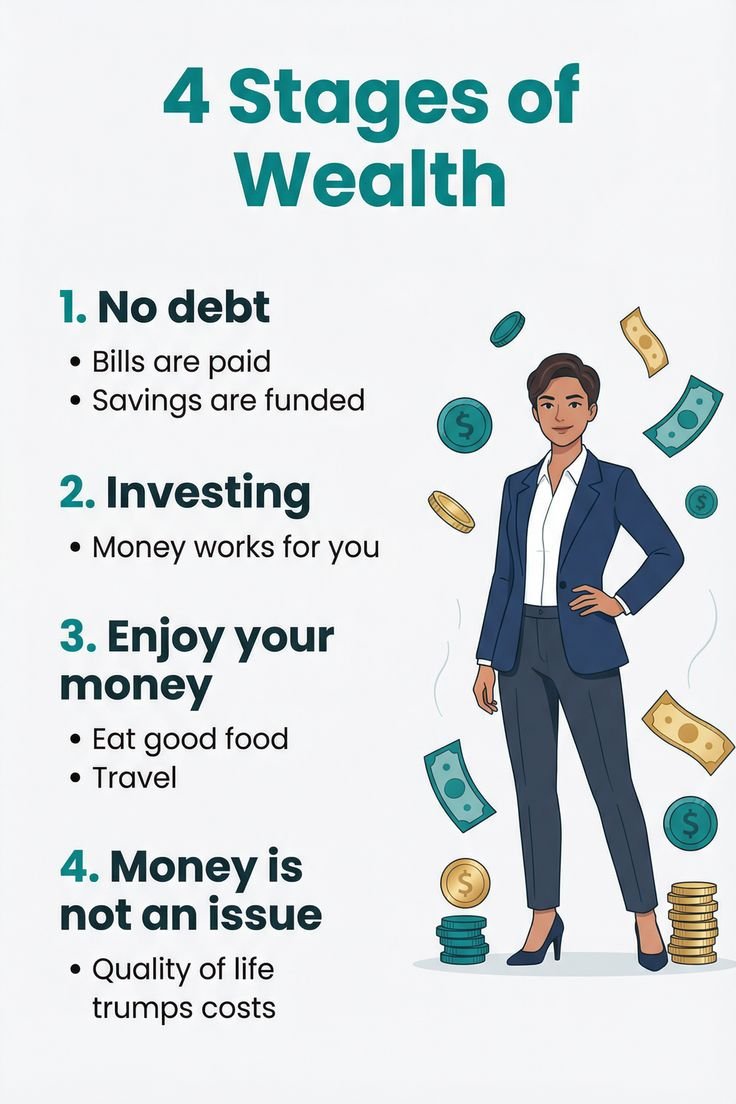


Building wealth is not only about earning a high income. It is also about developing good financial habits, controlling expenses, saving consistently, investing for the long term, and making thoughtful financial decisions.
Starting when you are young can give you an important advantage: time. The earlier you begin developing healthy financial habits, the more time your savings and investments may have to grow.
You do not need to be wealthy to start building wealth. Even small amounts of money, when managed consistently, can become part of a larger financial strategy.
1. Learn How Money Works
One of the first steps toward building wealth is developing financial knowledge.
Learn the basics of:
- Budgeting
- Saving
- Investing
- Credit
- Debt
- Taxes
- Retirement accounts
- Interest
- Insurance
Understanding these concepts can help you make better decisions as your income increases.
Financial education does not mean you need to become an expert. Start with the basics and gradually learn more as your financial situation becomes more complex.
2. Start Saving Early
Saving money is one of the simplest wealth-building habits you can develop.
Even if you can only save $25, $50, or $100 per month, creating the habit early can be valuable.
For example, saving $100 per month would result in:
$100 × 12 months = $1,200 per year.
After five years, that would be $6,000 before considering any interest or investment returns.
As your income increases, you can gradually increase the amount you save.
3. Build an Emergency Fund
Before taking significant investment risks, consider building an emergency fund.
An emergency fund can help cover unexpected expenses such as:
- Car repairs
- Medical costs
- Home repairs
- Temporary loss of income
- Emergency travel
- Other essential expenses
A commonly used goal is several months of essential living expenses, although the appropriate amount depends on your circumstances.
Keeping emergency savings can also reduce the need to rely on high-interest credit cards when unexpected costs occur.
4. Create a Budget
A budget helps you control where your money goes.
Start by calculating your monthly income and listing your expenses.
For example, if you earn $4,000 per month, you could create categories for:
- Housing
- Food
- Transportation
- Utilities
- Insurance
- Debt payments
- Savings
- Investments
- Entertainment
Your exact percentages will depend on your circumstances.
The goal is to spend intentionally rather than allowing your money to disappear without a plan.
5. Avoid Lifestyle Inflation
As your income increases, it can be tempting to increase your spending at the same rate.
For example, someone receiving a $10,000 annual raise might immediately upgrade their car, move into a more expensive apartment, and increase entertainment spending.
While enjoying some of your additional income is reasonable, directing part of it toward savings and investments can help improve your long-term financial position.
This habit is sometimes described as avoiding unnecessary lifestyle inflation.
6. Be Careful With Debt
Debt can be useful in some situations, but high-interest debt can make building wealth more difficult.
Credit card debt is particularly important to manage because interest charges can accumulate quickly when balances are carried over time.
Before taking on debt, consider:
- The interest rate
- Fees
- Repayment period
- Total cost
- Whether the purchase is necessary
Paying down expensive debt can be an important part of a wealth-building strategy.
7. Start Investing for the Long Term
Investing can help your money potentially grow over time.
Common investments include:
- Stocks
- Bonds
- Mutual funds
- Exchange-traded funds
- Real estate
Each investment carries different risks.
Young investors often have a longer time horizon, which may give them more time to experience market ups and downs. However, a longer time horizon does not eliminate investment risk.
Before investing, understand what you are buying and how much you could potentially lose.
8. Take Advantage of Retirement Accounts
For people working in the United States, retirement accounts can be an important part of long-term financial planning.
Employer-sponsored plans such as 401(k) plans may allow workers to contribute part of their income toward retirement. Some employers also provide matching contributions under their plan rules.
Individual Retirement Accounts, including Traditional IRAs and Roth IRAs, can also be useful depending on eligibility and individual circumstances.
Starting retirement contributions early can give your money more time to potentially grow.
9. Understand Compound Growth
Time is one of the most powerful factors in long-term investing.
Compound growth occurs when returns remain invested and future returns can potentially be earned on both the original money and previous returns.
For example, suppose you invest $5,000 and it grows at a hypothetical average annual rate of 7%, with returns reinvested.
After several years, the potential value can become significantly larger than the original investment because growth can build on previous growth.
However, actual investment returns are not guaranteed. Markets can decline, and investments can lose money.
The example simply demonstrates why starting early can matter.
10. Increase Your Earning Potential
Saving and investing are important, but your ability to earn money is also a major part of wealth building.
Focus on developing valuable skills that can increase your career opportunities.
Depending on your field, these could include:
- Technology
- Data analysis
- Communication
- Sales
- Management
- Skilled trades
- Healthcare
- Finance
- Digital marketing
You can improve your skills through education, professional certifications, practical experience, or independent learning.
As your earning potential increases, you can direct more money toward financial goals.
11. Develop Multiple Sources of Income
Some people choose to build additional income streams alongside their primary employment.
Examples include:
- Freelancing
- Consulting
- Online services
- Small businesses
- Rental income
- Digital products
- Part-time work
An additional income source can provide more money for savings, debt repayment, or investing.
However, building a second income stream requires time and effort, and not every opportunity will be profitable.
Be cautious of programs promising easy or guaranteed income.
12. Avoid Get-Rich-Quick Schemes
Building wealth generally takes time.
Be cautious of anyone promising that you can become wealthy quickly with little work or no risk.
Warning signs can include:
- Guaranteed high returns
- Pressure to invest immediately
- Requests to send money before receiving detailed information
- Unclear business models
- Claims that an opportunity is completely risk-free
If an investment sounds too good to be true, research it carefully before committing money.
13. Protect the Wealth You Build
Building wealth is only part of financial planning. Protecting it also matters.
Depending on your circumstances, this can include appropriate insurance coverage, maintaining emergency savings, protecting important financial accounts, and keeping personal information secure.
As your financial situation becomes more complex, professional financial or tax advice may also be useful.
14. Make Financial Goals Specific
Instead of saying:
“I want to become wealthy.”
Create specific goals.
For example:
- Save $5,000 for an emergency fund.
- Pay off $10,000 of high-interest debt.
- Invest $300 every month.
- Increase retirement contributions each year.
- Save $20,000 toward a home down payment.
Specific goals make it easier to measure progress.
15. Review Your Financial Progress
Your financial plan should change as your life changes.
Review your finances periodically and look at:
- Income
- Expenses
- Savings
- Debt
- Investments
- Retirement contributions
- Financial goals
You may need to adjust your plan after changing jobs, moving, getting married, having children, starting a business, or experiencing another major life change.
A Simple Wealth-Building Plan for Young Adults
A basic approach could look like this:
Step 1: Learn the fundamentals of personal finance.
Step 2: Create a realistic budget.
Step 3: Build emergency savings.
Step 4: Manage high-interest debt.
Step 5: Increase your skills and earning potential.
Step 6: Contribute toward retirement when possible.
Step 7: Invest according to your goals and risk tolerance.
Step 8: Avoid unnecessary lifestyle inflation.
Step 9: Continue learning about money.
Step 10: Review your financial progress regularly.
Final Thoughts
Building wealth from a young age is less about finding a quick way to become rich and more about creating strong financial habits early.
Save consistently, spend intentionally, manage debt carefully, invest for appropriate long-term goals, develop valuable skills, and give your money time to potentially grow.
You do not need to start with a large amount of money. The most important step is to begin with a realistic plan and improve it over time.
Financial success does not look exactly the same for everyone. What matters is building a financial strategy that fits your income, goals, responsibilities, and risk tolerance.
Educational note: This article is for general educational purposes and is not personalized financial, tax, or investment advice. Investment returns are not guaranteed, and individual financial circumstances vary.