



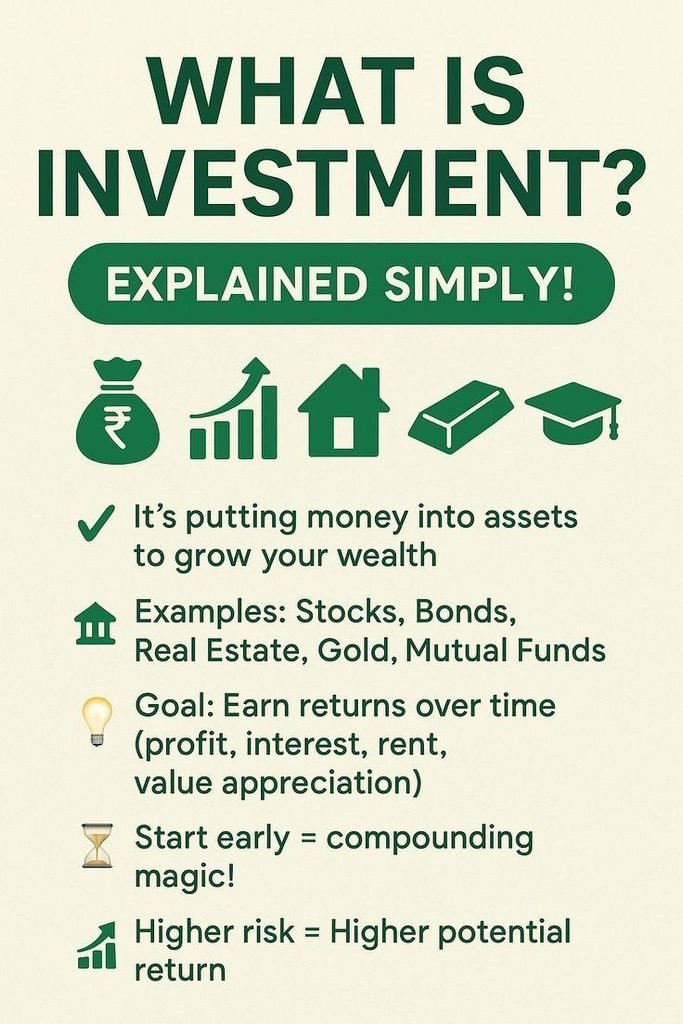
Investing is an important part of personal finance and long-term financial planning. While saving money can help you prepare for emergencies and short-term goals, investing can provide an opportunity to grow your money over a longer period.
Many people associate investing with the stock market, but investing includes much more than buying individual stocks. People can invest in bonds, mutual funds, exchange-traded funds, real estate, businesses, and other assets.
Understanding what investing means and why it matters can help you make more informed financial decisions and determine whether investing belongs in your financial plan.
What Is Investing?
Investing means putting money or other resources into an asset or activity with the expectation that it may generate income, increase in value, or provide another financial benefit over time.
For example, when you purchase shares of a company, you are investing in that business. If the value of the shares increases, you may be able to sell them for more than you paid. Some investments may also provide income through dividends or interest.
However, investing always involves some level of risk. An investment can lose value, and there is no guarantee that you will receive a profit.
This is one of the main differences between investing and simply keeping money in a traditional savings account.
Why Does Investing Matter?
Investing can matter because money that is not invested may lose purchasing power over time as prices increase.
Inflation means that the prices of many goods and services tend to rise over time. If your money earns little or no return while prices increase, the amount of goods and services you can purchase with that money may decline.
Investing may provide an opportunity for your money to grow over the long term.
However, investment returns are not guaranteed, and different investments carry different risks.
Investing Can Help With Long-Term Goals
Investing is often used for long-term financial goals.
One of the most common examples is retirement. Retirement may be decades away for a young worker, giving invested money potentially more time to grow.
Other long-term goals may include building wealth, funding education, purchasing property, or creating additional financial resources.
The appropriate investment strategy depends on the goal and how long you have before you need the money.
Money needed in the near future may require a different approach from money intended for a goal several decades away.
The Power of Compounding
One reason investing can be powerful over long periods is compounding.
Compounding occurs when returns generated by an investment are reinvested and potentially generate additional returns.
For example, suppose you invest money and it earns a return. If you leave the original investment and its earnings invested, future returns may be calculated on a larger amount.
Over many years, this process can potentially have a significant effect.
Compounding does not guarantee investment profits, and actual returns can vary. However, time can be an important factor in long-term investing.
Common Types of Investments
There are many types of investments available to investors.
Stocks
Stocks represent ownership in a company. When you buy shares, you become a shareholder.
Stocks can potentially increase in value and some companies pay dividends. However, stock prices can also decline, sometimes significantly.
Bonds
Bonds are generally debt investments. When you purchase a bond, you are effectively lending money to an issuer, such as a government or company.
The issuer typically agrees to make interest payments and return the principal according to the terms of the bond.
Bonds have risks too, including interest-rate and credit risks.
Mutual Funds
A mutual fund pools money from multiple investors and uses that money to purchase a collection of investments.
Mutual funds can provide diversification because a single fund may hold many securities.
Exchange-Traded Funds
Exchange-traded funds, commonly called ETFs, also hold collections of investments and trade on exchanges.
Some ETFs track broad market indexes, while others focus on specific industries, regions, or investment strategies.
Real Estate
Real estate can be another form of investment. People may purchase property with the intention of earning rental income, benefiting from potential appreciation, or both.
Real estate can require significant capital and may involve expenses such as maintenance, taxes, insurance, and financing costs.
What Is Diversification?
Diversification means spreading investments across different assets rather than putting all your money into one investment.
For example, instead of investing all your money in one company’s stock, you could own a broader collection of investments.
Diversification can reduce the impact of poor performance from a single investment, although it cannot eliminate investment risk.
How much diversification you need depends on your investment strategy, goals, and circumstances.
What Is Investment Risk?
Investment risk is the possibility that an investment will lose value or produce a different return than expected.
Stocks can experience significant price changes. Bonds can be affected by interest-rate movements and the financial condition of the issuer. Real estate can be affected by property values, local economic conditions, and other factors.
Generally, investments with greater potential returns can also involve greater risk.
Before investing, it is important to understand how much risk you are comfortable taking and how much risk your financial situation can reasonably handle.
Investing vs. Saving
Saving and investing serve different purposes.
Savings are generally used for short-term needs and emergencies. A savings account can provide relatively easy access to your money.
Investing is generally more appropriate for longer-term goals where you may be able to tolerate market fluctuations.
For example, money needed for an emergency next month generally should not be treated the same way as money being invested for retirement decades from now.
Having both savings and investments can therefore be part of a broader financial plan.
When Should You Start Investing?
There is no universal age at which everyone should begin investing.
Before investing, it can be useful to establish a basic financial foundation. This may include having money for essential expenses, maintaining an emergency fund, and managing high-interest debt.
Once those priorities are reasonably addressed, you can consider investing for longer-term goals.
Starting earlier can provide more time for potential growth and compounding, but starting later does not mean investing is pointless.
The most important consideration is to create a strategy appropriate for your circumstances.
How Can Beginners Start Investing?
Beginners should start by learning the basics.
Understand the investment you are considering, including its potential risks, fees, expected time horizon, and how it fits into your overall financial goals.
You can also explore diversified investment options rather than immediately trying to select individual stocks.
If you have access to an employer-sponsored retirement plan, review the investment choices available within the plan and understand how contributions work.
For complex financial decisions, a qualified financial professional may be able to provide guidance based on your individual circumstances.
Common Investing Mistakes to Avoid
New investors can make several common mistakes.
One is investing money that they may need immediately. Another is putting too much money into a single investment.
Trying to make quick profits by constantly buying and selling investments can also expose investors to additional risks and costs.
Investors should also be cautious about making decisions based entirely on social media trends, online rumors, or promises of guaranteed returns.
If an investment opportunity sounds too good to be true, take time to research it carefully.
Final Thoughts
Investing is the process of putting money into assets with the goal of generating income, growth, or another financial benefit over time. It can play an important role in long-term financial planning, particularly for goals such as retirement and wealth building.
However, investing is not guaranteed to make money. Investments can lose value, and different assets carry different levels of risk.
A thoughtful approach starts with understanding your financial situation, establishing appropriate savings, identifying your goals, learning about different investment options, and choosing a strategy that fits your time horizon and risk tolerance.
You do not need to understand every investment before you begin learning about personal finance. Start with the basics, continue building your knowledge, and make financial decisions carefully as your goals and circumstances develop.