


Stocks and bonds are two of the most commonly discussed investments in personal finance. Beginners often hear about them when learning about investing, retirement planning, or building a diversified portfolio. Although both can be used to potentially grow wealth over time, stocks and bonds work in very different ways.
Understanding the difference between them can help new investors better understand how financial markets work and why people may use both types of investments in their financial plans.
What Are Stocks?
A stock represents an ownership interest in a company. When you purchase shares of a publicly traded company, you become a shareholder.
As a shareholder, you may benefit if the company’s value increases and its stock price rises. Some companies also pay dividends, which are distributions of money to shareholders.
However, stock prices can also fall. If the company performs poorly or market conditions change, the value of your investment may decline.
Stocks therefore have the potential for significant long-term growth but also involve the possibility of losing money.
What Are Bonds?
A bond is generally a form of debt.
When you purchase a bond, you are typically lending money to the issuer. The issuer could be a government, municipality, corporation, or another organization.
In exchange, the issuer generally agrees to make interest payments according to the bond’s terms and return the principal at maturity.
For example, if you purchase a $1,000 bond with a stated interest rate, the issuer may make scheduled interest payments and return the $1,000 principal when the bond matures, assuming the issuer meets its obligations.
Bonds are not risk-free. Their values can change, and issuers can sometimes fail to make required payments.
Stocks vs. Bonds: The Main Difference
The simplest way to understand the difference is this:
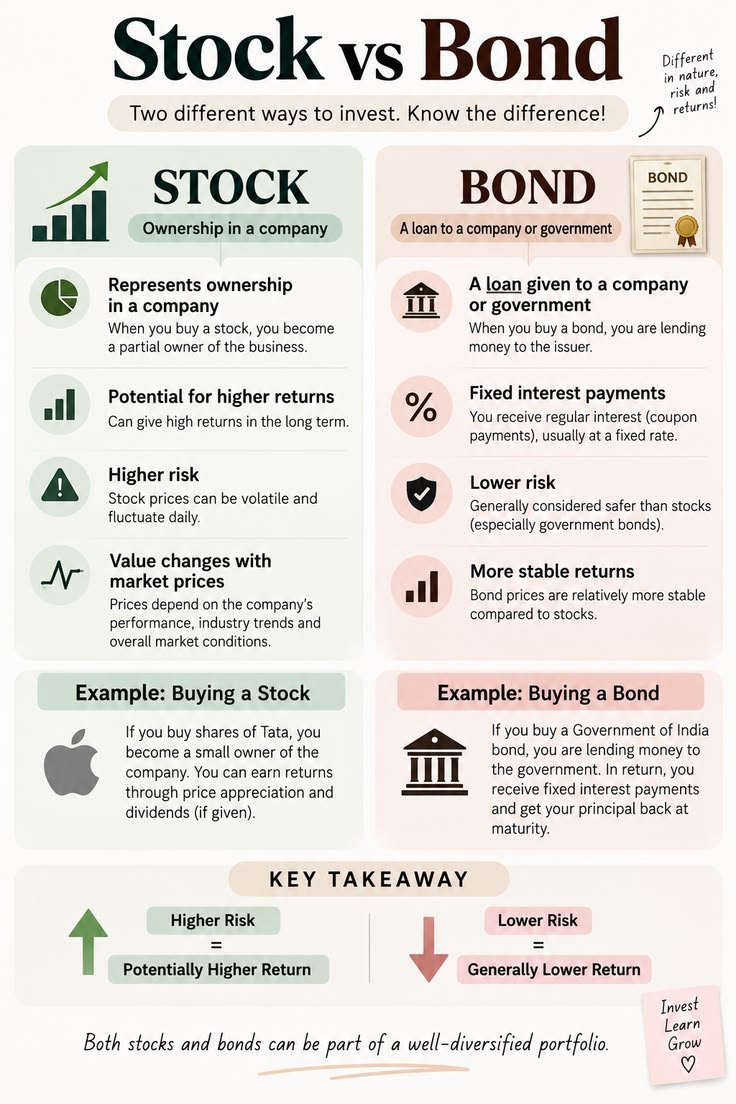
Stocks represent ownership, while bonds generally represent lending.
When you buy stock, you are purchasing part of a company.
When you buy a bond, you are generally lending money to an issuer.
This difference affects how investors can potentially make money and what types of risks they face.
How Do Investors Make Money From Stocks?
There are generally two ways investors may benefit from owning stocks.
The first is capital appreciation. If you purchase a stock for $50 per share and later sell it for $70, you have a $20 gain per share before considering taxes and transaction costs.
The second is dividend income. Some companies distribute part of their profits to shareholders through dividends.
However, neither price appreciation nor dividends is guaranteed. A stock can lose value, and companies can reduce or eliminate dividends.
How Do Investors Make Money From Bonds?
Bond investors generally receive interest payments according to the terms of the bond.
For example, a bond may pay interest periodically until it reaches maturity. At maturity, the issuer generally repays the principal if it meets its obligations.
However, bond prices can change before maturity. If you sell a bond before it matures, you may receive more or less than the amount you originally paid.
Bond prices are influenced by factors including interest rates, the issuer’s creditworthiness, and market conditions.
Risk Differences Between Stocks and Bonds
Stocks and bonds involve different types and levels of risk.
Stocks can experience substantial price fluctuations. Economic conditions, company performance, interest rates, investor expectations, and many other factors can affect stock prices.
Bonds can also lose value. One important risk is interest-rate risk. When market interest rates rise, existing bonds with lower interest rates can become less attractive, which can cause their market prices to fall.
Bonds also have credit risk, which is the possibility that the issuer may not make the required payments.
The level of risk varies significantly among different stocks and bonds.
Which Has Greater Growth Potential?
Historically, stocks have generally offered greater long-term growth potential than high-quality bonds, but they also tend to involve greater volatility and risk.
Bonds generally offer lower growth potential than stocks, although this depends on the type of bond and market conditions.
An investor’s choice should therefore consider both potential return and the amount of risk they can reasonably accept.
There is no guarantee that either stocks or bonds will produce a particular return.
Why Do Investors Own Both?
Some investors hold both stocks and bonds because the two asset classes can behave differently under various market conditions.
A portfolio containing multiple asset classes can provide diversification.
For example, an investor might hold stocks for long-term growth potential and bonds for income or diversification.
The appropriate mix depends on factors such as age, financial goals, investment time horizon, income, and risk tolerance.
What Is Diversification?
Diversification means spreading investments across different assets rather than putting all your money into one investment.
For example, instead of purchasing shares in only one company, an investor could use a diversified fund that owns shares of many companies.
Similarly, a bond portfolio could include bonds issued by different organizations or with different maturities.
Diversification can reduce the impact of poor performance from a single investment, although it cannot eliminate investment risk.
Stocks and Bonds in Retirement Accounts
Stocks and bonds can both be held inside retirement accounts such as a 401(k) or IRA, depending on the investment choices available in the account.
A retirement account is different from an investment itself. The account provides a structure for holding investments and may provide tax advantages depending on the account type.
Within a retirement account, an investor may choose investments that include stocks, bonds, mutual funds, ETFs, or other available options.
Understanding the difference between the account and the investments held inside it is important for beginners.
How Should Beginners Think About Stocks and Bonds?
Beginners should avoid thinking about stocks and bonds as competing investments where one is automatically better than the other.
They serve different purposes and carry different risks.
Instead, consider your financial goals.
If you are investing for a goal several decades away, you may have more time to tolerate market fluctuations. If you are approaching a financial goal and cannot afford significant losses, you may need to think differently about how much risk you take.
Your investment mix should reflect your personal circumstances rather than simply following what someone else is doing.
A Simple Example
Imagine two investors each have $10,000 to invest.
Investor A puts all $10,000 into a diversified stock fund. The investment may have greater long-term growth potential, but its value could fluctuate significantly.
Investor B divides the money between a stock fund and a bond fund. This investor may experience less exposure to stock-market movements, although the portfolio can still lose value.
Neither approach is automatically appropriate for everyone. The suitable allocation depends on the investor’s goals, time horizon, and risk tolerance.
Final Thoughts
Stocks and bonds are fundamentally different investments.
Stocks represent ownership in companies and can provide potential growth through rising share prices and dividends. Bonds generally represent loans to governments, corporations, or other issuers and can provide interest payments according to their terms.
Stocks generally have greater long-term growth potential but can experience larger price fluctuations. Bonds can provide income and diversification but also face risks such as interest-rate and credit risk.
For beginners, understanding these differences is an important step toward learning how to build an investment strategy. Rather than choosing investments based solely on recent performance, consider your financial goals, investment time horizon, and ability to tolerate losses.
Stocks and bonds can both play a role in a diversified portfolio, but the right combination depends on each investor’s individual financial situation.