


Investing can be an effective part of a long-term financial plan, but getting started can also be confusing. Beginners often encounter a large amount of information about stocks, funds, cryptocurrency, real estate, retirement accounts, and other investments.
Without a clear strategy, it is easy to make decisions based on emotions, incomplete information, or unrealistic expectations.
The good news is that many common investment mistakes can be avoided by learning the basics and taking a thoughtful approach. Understanding potential mistakes before investing can help you protect your money and make more informed decisions.
1. Investing Without an Emergency Fund
One common mistake is investing money that may be needed for unexpected expenses.
Investments can lose value, sometimes at the exact time you need the money. If you do not have emergency savings, you may be forced to sell an investment during a market decline.
Before investing significant amounts, consider establishing an emergency fund that can cover unexpected expenses.
The appropriate amount depends on your income, expenses, job stability, and personal circumstances.
2. Ignoring High-Interest Debt
Another mistake is investing heavily while carrying expensive high-interest debt.
For example, credit card balances can accumulate substantial interest if they are not paid in full. The interest you pay on debt can outweigh the potential returns from some investments.
This does not mean you must eliminate every form of debt before investing. However, it is important to understand your interest rates and consider how debt repayment fits into your overall financial plan.
3. Investing Without Understanding the Investment
Never invest simply because someone tells you that something is a good opportunity.
Before putting money into an investment, understand what it is, how it works, what affects its value, and what could cause you to lose money.
If you cannot explain in simple terms what you are investing in, take more time to research it.
Important questions include:
- What does the investment own?
- How does it generate returns?
- What are the fees?
- What are the risks?
- How easily can you sell it?
- How long should you expect to hold it?
Understanding these factors can help you make more informed decisions.
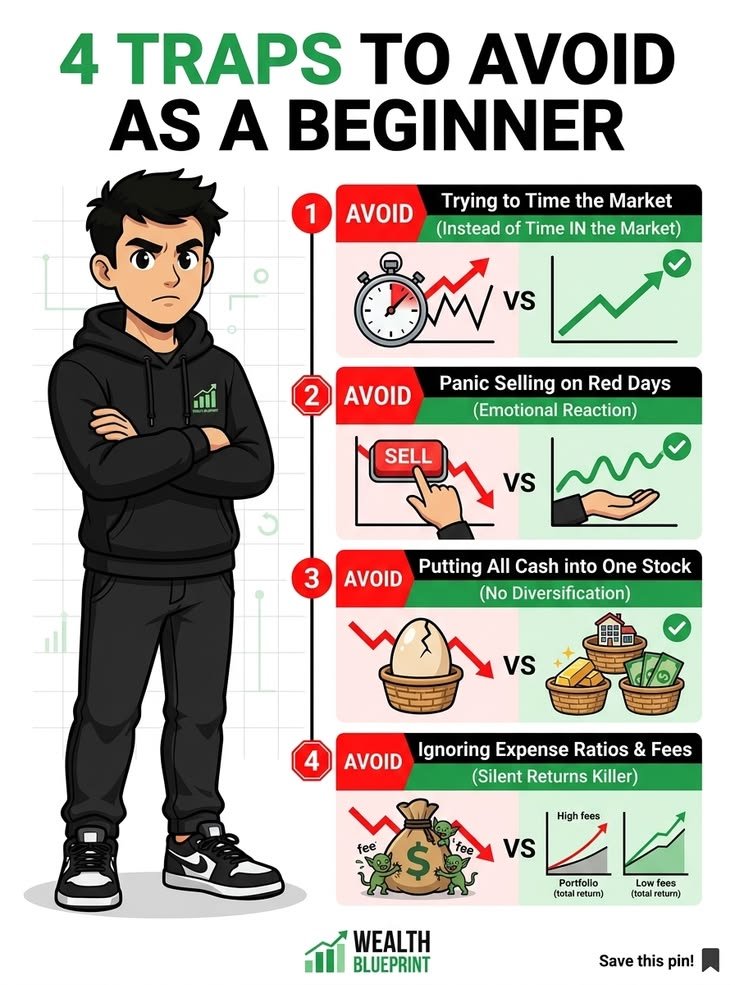
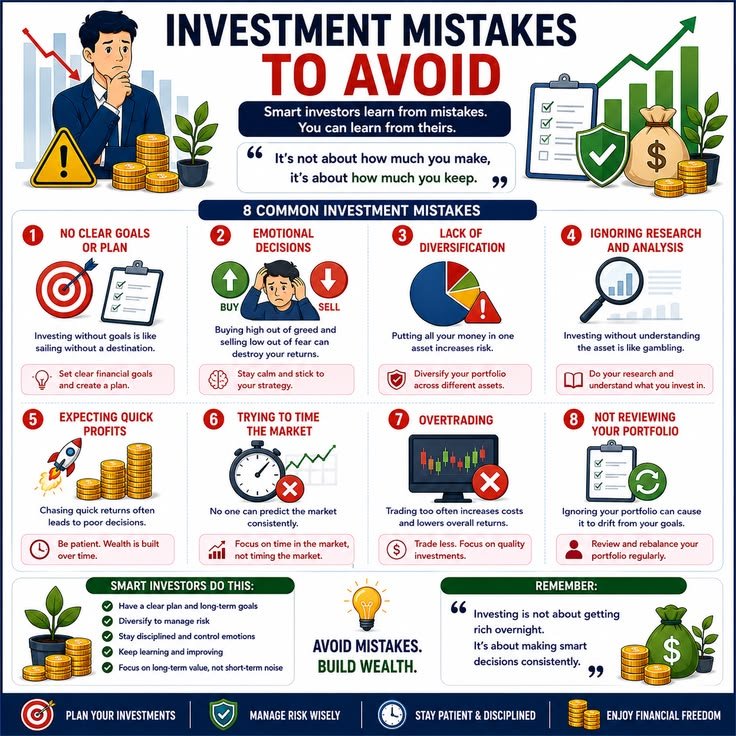
4. Trying to Time the Market
Many beginners attempt to predict the perfect time to buy and sell investments.
The problem is that consistently predicting short-term market movements is extremely difficult.
An investor may wait for prices to fall before buying, only to see the market rise instead. Similarly, an investor may sell because prices are falling and miss a later recovery.
A long-term strategy based on consistent investing may be easier to maintain than constantly trying to predict market movements.
5. Making Emotional Decisions
Fear and excitement can strongly influence investment decisions.
When markets rise rapidly, investors may become overly optimistic and buy because they do not want to miss out. When markets fall, fear may cause them to sell without considering their long-term goals.
Market volatility is a normal part of investing.
Having a clear investment plan can help you make decisions based on your goals and time horizon rather than short-term emotions.
6. Putting Too Much Money Into One Investment
Concentration can create significant risk.
If most or all of your investment portfolio is tied to one company, industry, or asset, poor performance in that area can have a major effect on your overall wealth.
Diversification spreads money across different investments and can reduce the impact of one investment performing poorly.
Diversification does not guarantee profits or prevent losses, but it can reduce concentration risk.
7. Chasing Past Performance
An investment that performed extremely well in the past may attract attention.
However, past performance does not guarantee future results.
A stock, fund, or other investment can have a strong historical performance and still decline in the future.
Instead of choosing an investment solely because its price has increased, research why it performed well and understand the risks involved.
8. Ignoring Fees
Investment fees may seem small, but they can affect long-term results.
Depending on the investment and account, you may encounter management fees, expense ratios, trading costs, account fees, or other charges.
Before investing, review the fees carefully.
Two investments with similar objectives may have different costs, and lower costs can leave more of your money invested.
However, fees should be considered alongside the overall quality, strategy, and suitability of an investment rather than viewed in isolation.
9. Following Social Media Investment Trends
Social media can provide useful educational information, but it can also encourage risky investment behavior.
Posts about stocks that are supposedly guaranteed to rise, overnight wealth, or “secret” investment opportunities should be treated carefully.
Online popularity does not prove that an investment is appropriate or safe.
Before making an investment decision, verify information using reliable sources and understand the risks independently.
10. Expecting Quick Wealth
Investing is generally a long-term process.
Beginners may expect to double their money quickly because of stories about people making large profits from certain investments.
However, high potential returns generally come with significant risk, and investments can lose value.
Be cautious about anyone promising guaranteed high returns with little or no risk.
Building wealth typically requires patience, consistent saving, and informed decision-making.
11. Investing Money You Cannot Afford to Lose
Investment money should generally be money you can leave invested for the appropriate time period.
If you need money for rent, groceries, debt payments, emergency expenses, or another immediate obligation, putting it into a volatile investment can create problems.
Separate money for short-term needs from money intended for long-term goals.
This distinction can help you avoid selling investments at an inconvenient time.
12. Forgetting About Taxes
Taxes can affect investment returns.
Different types of investment income and gains can receive different tax treatment in the United States. Retirement accounts can also have specific tax rules.
Before making significant investment decisions, understand how taxes may affect the account or investment you are considering.
For complicated situations, consider consulting a qualified tax or financial professional.
13. Checking Investments Too Often
It may seem responsible to check your investments every hour or every day, but frequent monitoring can encourage emotional decisions.
If you are investing for a long-term goal, daily price movements may have little relevance to your ultimate objective.
Review your portfolio periodically to make sure it remains aligned with your goals, but avoid making unnecessary changes simply because prices moved during the week.
14. Failing to Have a Clear Goal
Investing without knowing why you are investing can make it difficult to choose an appropriate strategy.
Saving for retirement is different from saving for a home you plan to purchase in two years.
Before investing, identify the purpose of the money, when you expect to need it, and how much risk you can reasonably accept.
Your investment strategy should reflect those factors.
15. Never Reviewing Your Investment Plan
Although constantly changing your investments can be a mistake, never reviewing them can also cause problems.
Your income, financial goals, family circumstances, and risk tolerance can change.
Review your financial plan periodically and determine whether your investments still match your objectives.
You may need to adjust your contributions or portfolio as your circumstances change.
Final Thoughts
Beginners can avoid many common investment mistakes by taking time to learn before putting their money at risk.
Some important principles include building emergency savings, understanding debt, researching investments, diversifying appropriately, controlling fees, avoiding emotional decisions, and maintaining realistic expectations.
Investing does not need to be complicated, but it should be approached carefully. No investment is guaranteed to produce a profit, and every investment involves some level of risk.
Rather than chasing quick gains or following the latest trend, focus on your financial goals, understand what you own, and develop an investment strategy that fits your circumstances.
The goal is not to avoid every market decline or make a perfect investment decision every time. The goal is to build responsible financial habits that can support your long-term financial objectives.